

Ethereum (ETH), the world’s second-largest cryptocurrency by market capitalization, sits at the epicenter of blockchain innovation. Its native token, ETH, is more than a digital currency—it underpins smart contracts, decentralized finance (DeFi), and non-fungible tokens (NFTs). The ETH price is not just a number on a chart; it’s a barometer of sentiment, utility, and the evolving narrative of decentralized technology. As Ethereum transitions to a proof-of-stake consensus with “The Merge” and plans further scalability upgrades, investors and analysts scrutinize the ETH price for signals on future trends.
Understanding where ETH’s price might be headed requires a synthesis of technical chart analysis, macroeconomic shifts, on-chain metrics, and a keen reading of decentralized application growth. With markets remaining volatile and innovation relentless, the stakes in predicting the next ETH price move have never been higher.
ETH Price Performance: Historical Insights and Current Trends
Ethereum has weathered several cycles of optimism and retracement since its launch in 2015. Its price journey—from humble beginnings below $1 to all-time highs (ATH) cresting above $4,000—mirrors the wider evolution and adoption of blockchain technology.
Key Milestones in ETH Price Development
- Early Adoption (2015–2017): ETH traded modestly until the ICO boom fuelled its first major surge.
- 2017 Bull Run: The growing DeFi ecosystem and the broader crypto rally saw ETH surpass $1,000 for the first time.
- 2018–2019 Bear Market: Price retraced sharply, but developer activity and stablecoin usage on Ethereum intensified.
- 2020–2021 Parabolic Growth: The NFT explosion and DeFi “summer” drove ETH to record highs above $4,000.
- Post-2022 Volatility: Global rate hikes and macroeconomic shifts caused corrections, but institutional interest remains notable.
Beyond these milestones, Ethereum’s enduring developer engagement and migration to proof-of-stake underpin long-term optimism. Yet, market cycles have proven unforgiving for leveraged speculation, underlining the need for disciplined analysis.
ETH Chart Analysis: Technical Signals & Key Levels
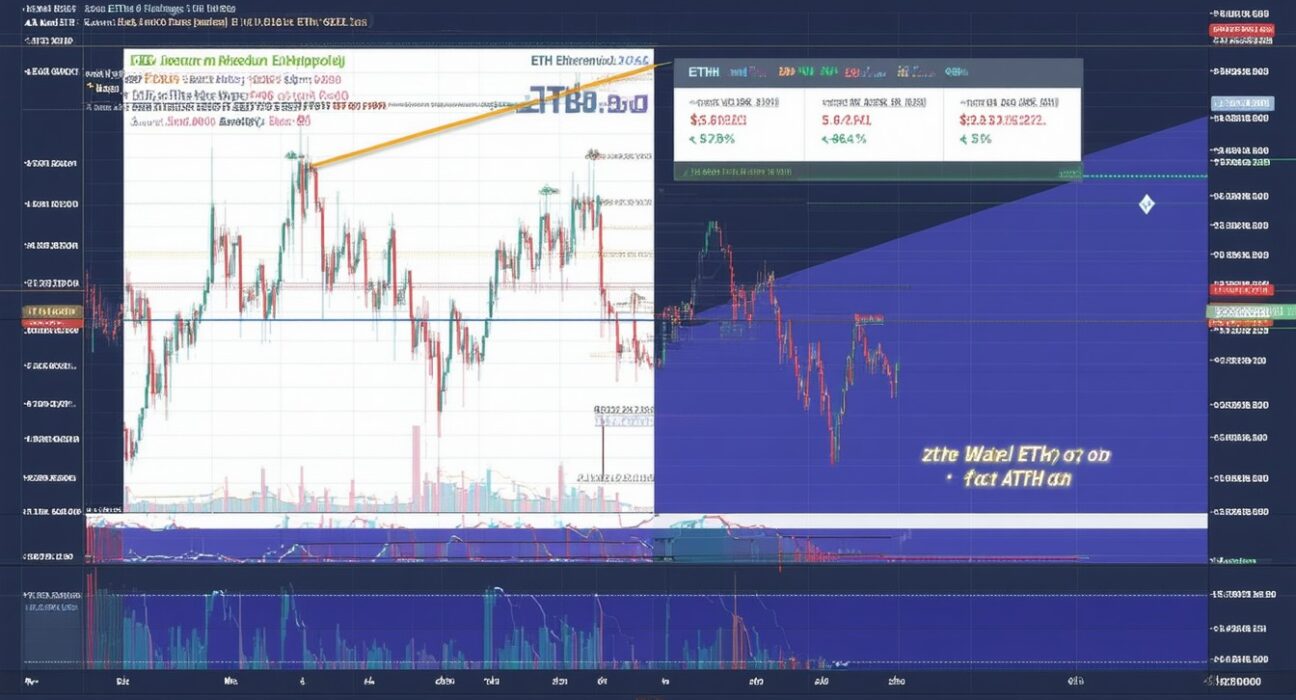
Technical analysis remains a vital toolkit for traders and investors seeking an objective lens on ETH price dynamics. Analyzing historical price charts often uncovers repeating patterns and psychological levels.
Support and Resistance: The Battlefield Zones
ETH’s price has repeatedly tested and respected certain price levels, which often act as support during downturns and resistance during rallies. For instance, past cycles have seen strong activity around round numbers—particularly the $1,000, $2,000, and $3,500 regions.
- Support levels: Recent corrections highlighted buying interest clustered near $1,800–$2,000, which historically has seen strong rebounds.
- Resistance zones: The $2,800–$3,200 range stands out as a recurring hurdle for breakouts.
Moving averages, like the 50-day and 200-day, offer further context. Crossovers between these averages (“golden crosses” or “death crosses”) often act as confirmation triggers for trend changes.
Momentum & Volume: Gauging Trader Sentiment
Momentum indicators such as Relative Strength Index (RSI) and Moving Average Convergence Divergence (MACD) help quantify whether ETH is overbought or oversold. Sustained readings above 70 on the RSI have preceded local tops, while dips below 30 signaled undervalued conditions for potential recovery.
Volume often tells the story behind a move. High trading volume on upward pushes confirms genuine interest, while weak bounce-backs on low volume may warn of a lack of conviction.
“Successful ETH traders combine technical analysis with macro awareness. Price patterns matter, but so do trends in regulation, technology upgrades, and overall crypto liquidity,” says digital asset strategist Ana Martinez.
Chart Patterns: Classical and Crypto-Specific
- Ascending triangles and double bottoms have preceded several breakouts during bull cycles.
- Bearish flags and descending channels often signal further downside in corrective phases.
While no pattern guarantees future performance, confluence between multiple indicators elevates confidence in forecasts.
Fundamental Drivers: Beyond the Charts
While technical signals offer crucial insights, underlying fundamentals drive ETH’s long-term value. Ethereum’s price is deeply entwined with its on-chain utility and ecosystem growth.
Supply Dynamics Post-Merge
The shift from proof-of-work to proof-of-stake with “The Merge” dramatically altered ETH’s monetary policy. With staking rewards replacing mining emissions, the rate at which new ETH enters circulation has slowed. In some periods, ETH has even become “deflationary” as transaction fees are burnt, reducing total supply. This scarcity narrative supports bullish price theses over multi-year timeframes.
Ecosystem Growth: DeFi, NFTs, and Layer-2
An increasing share of decentralized finance (DeFi) protocols, stablecoins, and NFT marketplaces are built atop Ethereum. Billions of dollars in total value locked (TVL) across these applications reflect real demand for ETH as “gas” to fuel transactions.
Layer-2 solutions—like Optimism and Arbitrum—promise lower fees and higher throughput. If these scaling strategies succeed, user adoption could accelerate, further boosting ETH’s utility and, potentially, price.
Macro Environment and Institutional Adoption
Crypto markets are not immune to broader economic narratives. Global monetary policy, regulation, and risk-on/risk-off sentiment among major funds all impact ETH flows. Recent years have seen several institutional products (like ETH ETFs in select jurisdictions) broaden access, increasing legitimacy and liquidity.
ETH Price Prediction: Scenarios and Considerations
Forecasting ETH’s future price is inherently uncertain due to its sensitivity to both crypto-native and macroeconomic shocks. Nonetheless, several high-probability scenarios emerge from available trends.
Bullish Case: Utility Drives Sustained Growth
- Rollout of Ethereum 2.0 upgrades unlocks new transaction capacity.
- Regulatory clarity brings institutional capital off the sidelines.
- Ecosystem innovation (e.g., tokenized real-world assets, next-gen NFTs) spurs usage.
Under such a scenario, ETH could revisit or exceed previous highs, especially if deflationary forces persist.
Bearish Case: Competition and Regulatory Overhang
- Emergence of rival smart contract platforms offering better scalability and lower fees.
- Unfavorable regulations deter DeFi/NFT growth.
- Macroeconomic shocks (e.g., a global recession) sap speculative and institutional appetite.
These pressures could see ETH testing lower support bands, with recoveries taking longer to materialize.
Neutral/Sideways Case: Consolidation and Waiting Game
- Progress on upgrades occurs, but adoption grows at a measured pace.
- Sideways trading persists as markets digest past cycles and await clear drivers.
This scenario could sustain the current trading range while longer-term fundamentals build beneath the surface.
Conclusion: Strategic Approaches in a Dynamic Market
Ethereum’s journey—from a developer-centric experiment to a global decentralized platform—makes the ETH price a focal point of both innovation and speculation. Chart patterns, technical signals, and on-chain metrics intersect to provide powerful, yet inherently imperfect, guidance.
Prudent investors monitor not just the ETH price, but the evolving landscape of adoption, competition, and regulatory shifts. Position sizing, risk management, and flexibility remain essential virtues for anyone navigating Ethereum’s future. As upgrades proceed and adoption intensifies, ETH’s role in a global digital economy seems likely to deepen, even as price cycles remain unpredictable.
FAQs
What factors influence the ETH price the most?
The ETH price is shaped by demand for decentralized applications, overall crypto market sentiment, technology upgrades, regulatory developments, and general macroeconomic conditions.
How does “The Merge” impact Ethereum’s value?
“The Merge” shifted Ethereum to proof-of-stake, reducing new ETH issuance and often leading to periods of net ETH deflation. This can support long-term scarcity narratives and potentially boost price.
Can technical analysis reliably predict ETH’s movements?
Technical analysis helps identify trends and potential turning points, but no method is foolproof. Combining chart signals with fundamental and macroeconomic insights leads to better decision-making.
Is ETH a good long-term investment?
Many investors see ETH as a core crypto asset due to its utility and ecosystem, but volatility and risks remain. Diversification and a long-term perspective are often recommended.
What role do DeFi and NFTs play in ETH’s valuation?
DeFi and NFT demand drive real usage of the Ethereum network, increasing need for ETH to pay transaction fees and bolstering its value proposition.
What are the main risks to Ethereum’s future price?
Risks include competition from alternative blockchains, technological setbacks, unfavorable regulations, and broader financial market downturns. Remaining alert to these factors is crucial for all participants.